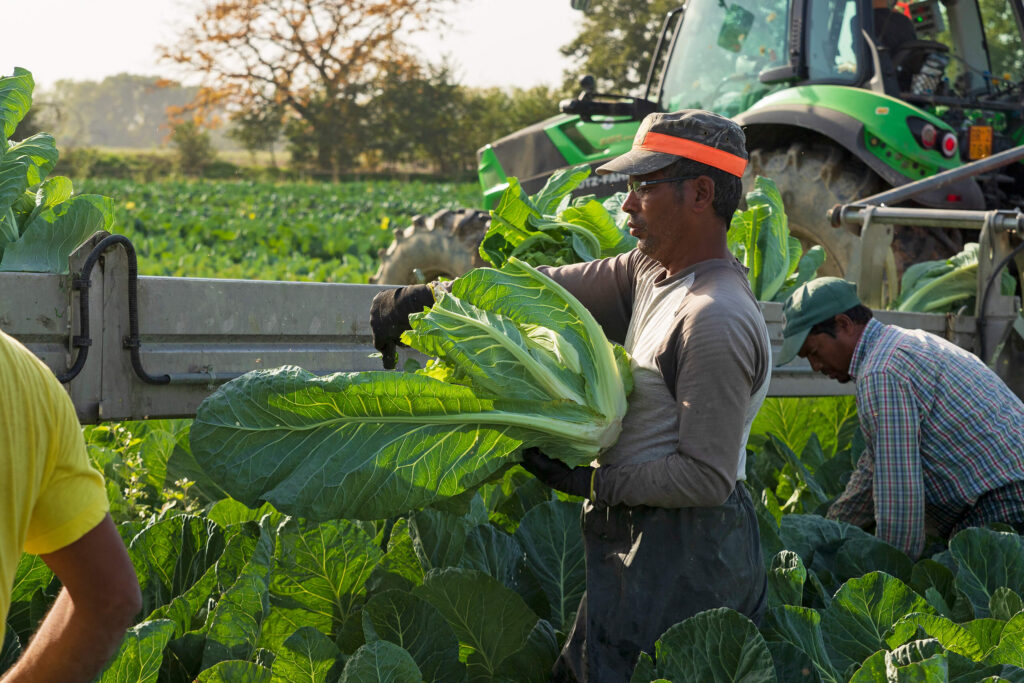
Brassicas are a very rich family (cabbages, savoy cabbages, cauliflowers and broccoli) but they are also products that do not forgive mistakes in timing and post-harvest handling. Top Melon has a full product page for brassicas because we know that, in B2B, the difference lies in concrete details: freshness, compactness, yield and shelf life.
In wholesale markets and large retail, flavour is rarely the problem. The problems are loss of turgor, dehydration, yellowing and variability between lots. So instead of saying “how good” brassicas are, we prefer to explain how we handle the most delicate part: delivering quality intact.
Why brassicas are so demanding after harvest
There is a physiological reason for their fragility. Many brassicas, and broccoli in particular, have a very high respiration rate after harvest: they keep “living” and using up their reserves, and this process speeds up sharply as temperature rises. Industry data show that the respiration heat of broccoli at 10°C and at 20°C is many times higher than at 0°C. Put simply, broccoli left in the heat “burns” its freshness many times faster than broccoli cooled straight away.
Cauliflower has a lower respiration rate but follows the same logic; in the right conditions, close to 0°C and with high relative humidity (around 90 to 95%), both keep much longer, whereas in the heat they lose value in a few days. This has two practical consequences for the supply chain:
- the time between harvest and cooling is a critical variable, not a detail: removing “field heat” quickly extends the product’s commercial life;
- the cold chain must be kept stable until delivery, with low temperatures and high humidity to limit dehydration and yellowing.
It is no coincidence that heat stress in the field without prompt cooling is widely recognised as a significant cause of post-harvest losses in summer fruit and vegetable production. For brassicas, where respiration is high, the margin for error is even narrower.
Ethylene: an invisible enemy
Besides temperature, brassicas such as broccoli are sensitive to ethylene, the ripening hormone: exposure to this gas speeds up yellowing and senescence. So cold alone is not enough: it also matters not to store the product alongside ethylene-producing fruit and to manage storage and transport carefully. It is another example of how, with brassicas, quality is above all a matter of process, not just the field.
Cool well and cool fast: the logic of pre-cooling
With brassicas, the first useful step is to remove field heat quickly. Pre-cooling, with forced cold air or cold water depending on the product, rapidly lowers the temperature of freshly harvested produce, slowing respiration and water loss even before storage. From then on, what counts is stability: an unbroken cold chain is worth more than a very cold but inconsistent cold room.
Not all brassicas are the same. Tighter, less active vegetables such as white and savoy cabbage tolerate longer storage; broccoli and cauliflower, on the other hand, are more perishable and need more care. In the right conditions, close to 0°C with high humidity, cauliflower can keep for several weeks, while broccoli has a shorter window of around one to two weeks. Knowing these differences is part of managing such a varied category without treating it as a single block.
Real yield is measured at destination
A common mistake is to assess brassicas only at dispatch. But the yield that really matters to buyers is the yield at destination: how much product still arrives fresh, compact and saleable after transport and the distribution platform. Two lots that leave identical can arrive very different if timing and temperature were managed differently. This is why, with these products, a supplier’s value lies not only in the field but in the ability to protect freshness to the very last step: that is what reduces claims and makes supply predictable week after week.
Quality and sustainability speak the same language: less waste
When we say sustainability we mean not only choices in the field but also reducing waste along the chain. A brassica that arrives in better condition sells better: lower waste is real sustainability as well as margin. With such perishable products, every improvement in managing timing and temperature translates directly into less unsold product and fewer returns, a result that suits both the income statement and the environment. It is consistent with agronomic choices such as integrated pest management, aimed at reducing impact, and with management based on data and tools (precision agriculture).
What really matters in B2B: timing and post-harvest process
With brassicas, the winner is often whoever best manages the stage after harvest. This is where packhouse procedures and checks come in: what happens to the product on arrival, how it is cooled, handled and protected, and what is standardised. We explain this in our article on what happens to produce after harvest.
This matters because it moves the conversation from “words” to “process”: how we work, what we check and what we make repeatable. Quality controls are the reference that holds everything together: measure and standardise where needed. As always, all this lives within the supply chain: with such sensitive products, organisation makes more difference than any single action.
A consumer link without losing the B2B angle
For buyers who also think about turnover and in-store communication, brassicas can be linked to a more consumer-oriented article already on our blog: Cabbage: goodness in every leaf. It remains secondary support: the focus of this article is the supply chain and freshness in distribution.
Freshness is a promise kept downstream
With brassicas the field matters, but the game is won (or lost) between harvest and delivery. We grow with love, but we know that in distribution love is measured in degrees, hours of handling and consistency of process.
We grow with love. Want to see how we carry quality through to distribution? Discover the Top Melon supply chain.
FAQ
Why is logistics so critical for brassicas?
Because they are physiologically “active” products: many brassicas, broccoli in particular, have a high respiration rate after harvest, which speeds up in the heat. Quality therefore depends on timing, the cold chain and post-harvest handling.
Why does broccoli deteriorate faster than other vegetables?
Because it has one of the highest respiration rates among vegetables, and it rises sharply with temperature: in the heat it quickly uses up its reserves, turns yellow and loses compactness. Prompt cooling is the main defence.
Which defects do buyers fear most in brassicas?
Loss of turgor, dehydration, yellowing and unevenness between lots: defects that arise mainly from poor management of temperature and timing after harvest. They often do not show at dispatch but emerge at destination, which is why they weigh so much in assessing a supplier.
Should all brassicas be handled the same way?
No. White and savoy cabbage tolerate longer storage, while broccoli and cauliflower are more perishable and need more attention to timing and the cold chain. Managing the category well means recognising these differences rather than treating it as a single block.
How can loss of freshness be limited?
By quickly removing field heat after cutting, keeping a stable cold chain with low temperatures and high humidity, and protecting the produce from ethylene exposure during storage and transport.
What makes the quality of Top Melon brassicas repeatable?
The combination of lower-impact agronomic choices (integrated pest management), post-harvest procedures and quality controls, all within a structured supply chain.
Does Top Melon only work with branded produce?
No: we can also supply programmes where the brand is not visible to the consumer. The guarantee lies in the process, not the label.
Where can I find a more consumer-oriented article on brassicas?
In our article on cabbage nutrition, varieties and recipes, a useful category resource alongside this B2B focus on the supply chain.