Courgettes are one of those products that look easy, but in B2B they are a test of precision: frequent harvesting, high sensitivity to handling and timing, and quality that can change quickly. Top Melon has a dedicated courgettes product page because we know that wholesale markets and retailers care about very concrete standards: regularity, freshness and yield.
Here too the retail rule applies: often the product is not branded. But buyers recognise a good supplier from waste, complaints and continuity of supply, not from the logo.
“Immature” by definition: why courgettes are so delicate
The first thing to understand about courgettes is that they are harvested immature, while still tender and in full physiological activity. This makes them valuable in the kitchen but fragile in the supply chain: after harvest they lose water and firmness very quickly, softening and losing their shine in a short time if not handled well. This is why harvesting is frequent (often daily or almost daily at peak production) and why the time between field and cold room becomes decisive.
Sensitivity to cold makes things more complicated: courgettes are a warm-season vegetable and, if stored at temperatures that are too low, they develop typical chilling injury. Industry studies show that even a few days at around 4°C can cause small pits on the skin, speeding up dehydration and softening and quickly reducing commercial value. The practical consequence is clear: courgettes must be cooled quickly, but not too much, finding a balance (generally cool but not cold temperatures, with high humidity) that slows water loss without triggering chilling injury.
What makes a courgette “commercial”: field plus management
Quality is not just appearance: it is also shelf life and uniformity. That is why the work is twofold. In the field, agronomic choices and resource management must be consistent with our approach to sustainability; downstream, a process is needed that takes the product to delivery without losing freshness, within a controlled supply chain.
To keep the cycle stable, water and nutrition become crucial. A well-irrigated, well-fed crop produces courgettes with more regular sizing and less stress. In practice this means water management, the use of objective data from weather stations and a precision agriculture approach. Fertigation also plays a supporting role, allowing water and nutrients to be managed in a more controlled way throughout the crop cycle.
Frequent harvesting and sizing: regularity starts in the field
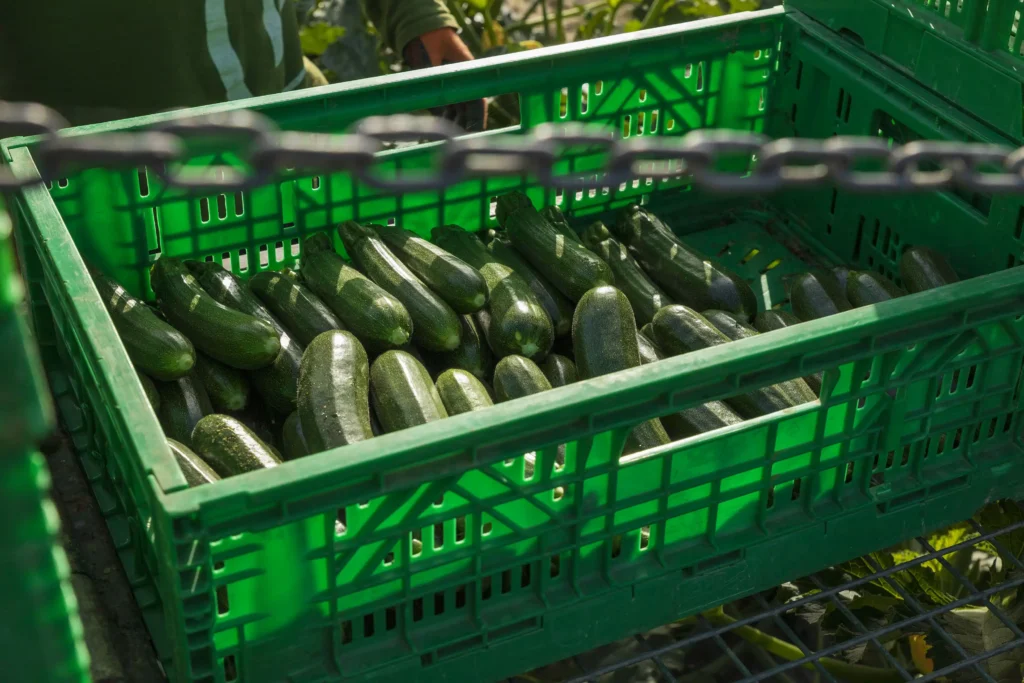
With courgettes, regularity starts at harvest. Because the fruit grows fast, it must be picked at the right size and very often: waiting too long means out-of-spec sizes and lower-value produce. For retailers, uniform sizing is almost more important than anything else: consistent packs are easier to price, display and sell. Well-planned, frequent harvesting is therefore the first condition for consistent lots, and it requires work organisation and presence in the field, not improvisation.
The hidden weak point: handling and post-harvest
With courgettes, the damage that matters most is often invisible at first: small pressure marks and micro-injuries caused by careless handling during harvesting, sorting and packing are not noticed straight away, but become entry points for rot and quality loss in the following days. Added to long delays before cooling and possible chilling injury, they are the main cause of claims.
This is why post-harvest handling is central, and packhouse procedures matter a great deal: how the product is moved, how carefully, how quickly and at what temperatures. We explain this in our article on what happens to produce after harvest.
At the same time, the logic of quality controls remains a reference: measure and standardise where needed. Not all checks are the same for different products, but the mindset is: quality as a process, not luck.
What the shelf really expects
From the store’s point of view, a courgette “that sells” is a sum of small things: smooth, shiny skin, firm texture, consistent size, and no bruises or signs of dehydration. These characteristics are built in the field but easily lost if post-harvest handling is not up to standard: a few extra hours in the heat, rough handling or the wrong temperature are enough to turn a good lot into produce that loses freshness sooner than expected. For such a perishable vegetable, the commercial promise is not “a good-looking courgette today” but a courgette that stays good long enough to reach the consumer fresh. This is where a well-run supply chain makes the difference compared with simply passing the product along.
Why all this is an advantage for buyers
With such a perishable product, the difference between suppliers is not the courgette on a good day: it is the ability to repeat quality on difficult days too, at harvest peaks and in the heat. A supplier that manages handling, timing and the cold chain well reduces waste and claims and offers more predictable freshness on the shelf. For buyers this is exactly what is needed: fewer surprises, more continuity.
Continuity of supply: the value you do not see straight away
For a crop harvested as frequently as courgettes, the real challenge is not the single load but continuity over the weeks. Planning sowings, being present in the field consistently and managing flows in the packhouse well make it possible to offer regular availability, without the gaps and peaks that complicate life for buyers. For a buyer, a supplier that regularly delivers the agreed quantity and quality is often worth as much as, if not more than, a single excellent lot. It is the difference between an occasional deal and a supply relationship to build planning on.
When the logo is not visible, what do you really sell in B2B?
You sell trust and continuity. And trust is built with the supply chain, procedures and the ability to deliver well, repeatedly, season after season. This is where our motto comes back: we grow with love, but we turn it into organisation.
We grow with love. Want to see how we manage each step from field to distribution? Discover the Top Melon supply chain.
FAQ
Why are courgettes “difficult” in logistics?
Because they are immature fruits, very sensitive to handling and timing: after harvest they quickly lose water and firmness and they dislike excessive cold. Freshness depends largely on post-harvest handling.
What is the right storage temperature?
It is a balance: cool them quickly to slow water loss, but without going too cold. Excessive cold (roughly from around 4°C for a few days) causes chilling injury, with pitting on the skin and softening. Cool but not cold temperatures with high humidity are best.
What is chilling injury in courgettes?
It is a physiological deterioration caused by temperatures that are too low: it shows as small pits on the skin, dehydration and softening, and makes the produce more prone to rot. It affects courgettes because they are warm-season vegetables.
What makes a courgette “commercial” beyond its looks?
Shelf life and uniformity across lots, as well as freshness: characteristics that come from field management (water and nutrition) together with careful post-harvest handling.
How do water and nutrition affect courgette quality?
A crop with balanced water supply and sensible nutrition gives more regular sizing and less stress. We rely on water management, data from weather stations and fertigation.
Why does uniform sizing matter so much to retailers?
Because consistent packs are easier to price, display and sell, and reduce in-store work. In courgettes, size depends on how often and how well harvests are planned: waiting too long gives out-of-spec sizes.
Are Top Melon courgettes always branded?
No: the packaging and the end customer change, not the method. The guarantee lies in the supply chain and the checks.
Where can I read more about Top Melon’s approach to resources?
In our article on how to manage water resources, which describes the operational choices behind our courgette growing too.