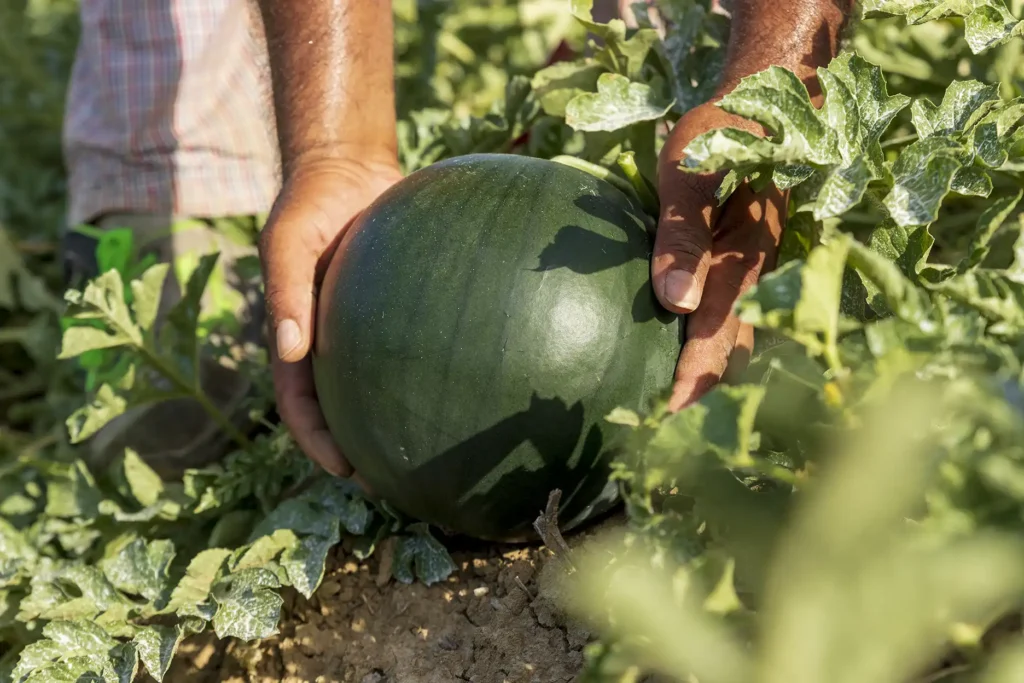
Regina is our midi watermelon branded Top Melon (discover Regina), a fruit designed for more practical consumption and less household waste. It is a precise product choice; but for B2B buyers the main question is not “what is it like” but how reliable it is in the supply chain, in logistics and in continuity of supply.
Here too a simple truth applies: in large retail the product often arrives without the Top Melon brand. What makes a midi watermelon truly “commercial” is its ability to arrive in good condition and hold up well on the shelf, and that depends on the journey, not the label (midi watermelon product page).
Why the midi size answers a real change
The traditional whole watermelon, however popular, has a practical limit: its weight and size make it less suited to small households and quick consumption. One slice today, one tomorrow, and often part of the fruit is left unused in the fridge. The midi size responds to a change in shopping habits that retailers know well: smaller households, single people, more frequent purchases in smaller quantities and greater attention to food waste.
From the store’s point of view, the benefits are concrete:
- more manageable portions, reaching shoppers who would not buy a whole watermelon;
- less household waste, a message increasingly valued by end customers;
- easier turnover and the chance to complete the range alongside full-size watermelons, reaching different consumer groups.
For the category manager, the midi does not “take” space from the large watermelon: it widens the pool of shoppers. But this size advantage only holds if the product is reliable lot after lot, and that is where the supply chain comes in.
A fruit that must be picked at the right moment: why the process matters
Watermelon has a feature that makes it demanding in the supply chain: it does not ripen after harvest. Unlike other fruits, what is harvested is what reaches the consumer, with no later “catching up”. This makes two things crucial: picking at the right stage of ripeness and handling the product with care, because knocks and pressure during harvesting, handling and transport can cause internal damage and cracks that reduce its value. At peak season, when volumes rise, the ability to manage all this without losing quality is what sets a reliable supplier apart.
This is a substantial difference from climacteric fruits, which keep ripening after harvest and “forgive” some imprecision at picking. With watermelon there is no such margin: picking too early or too late has consequences that cannot be corrected later. This is why skill in the field (reading ripeness, harvesting at the right time and handling with care) is as much part of commercial quality as what happens later in the packhouse.
A range builder, not an internal competitor
In category terms, the midi size should not be seen as a duplicate of the traditional watermelon, but as a product that broadens the audience. It appeals to those looking for convenience, people living alone or in couples, and those who want to try without committing to a whole fruit. In many cases it becomes an impulse or trial purchase, with a lower entry barrier. For the store this means covering different consumer groups within the same category and increasing sales opportunities over the season. But for the strategy to work, the midi must keep consistent quality and availability: a convenient format that disappoints on sweetness or shelf life quickly loses the trust it has gained. Once again, consistency comes from the supply chain.
From field to distribution: where real quality is decided
A midi watermelon is not judged only on sweetness. It is judged on integrity, shelf life, uniformity across lots and the ability to handle peak-season volumes. This is why our work rests on three elements that, in B2B, reduce risk and increase predictability:
- a structured supply chain that governs every step from field to delivery;
- a traceability approach that links lots and stages;
- the principles of supply chain traceability, with identification of incoming produce and a lot number assigned on arrival at the packhouse, where every item in contact with the fruit is managed with its own traceability.
Checks and packing: the standard before delivery
In our model, checking means measuring and managing, not “hoping”. Quality controls are a pillar and work together with what happens at the packhouse after harvest, the stage when a product becomes “safer” for wholesale markets and retailers: less variability, fewer surprises, less waste. Uniform size and fruit integrity, in particular, are what make a lot of midi watermelons easy to manage on the shelf.
There is also a sustainability thread linking size and supply chain: a fruit designed to reduce household waste only makes full sense if it does not generate waste upstream, along the chain. Reducing waste and claims with a solid supply chain is an integral part of our approach to sustainability, closing the circle between the product’s promise and the way it is produced.
Volumes, size and logistics: the peak-season test
Watermelon has a concentrated season: at its peak, volumes rise quickly and the ability to manage them without lowering quality becomes a competitive factor. For retailers, uniform sizing matters most: consistent pallets and packs are easier to manage on the shelf, easier to price and reduce in-store work. In this sense the midi size has a built-in logistical advantage (lower weights, easier handling) but still requires careful grading so that its promise of convenience stays consistent all season long.
Temperature management also matters: watermelon does not tolerate sudden changes or unsuitable storage well, so it must be handled with care along the whole chain, from field to transport. Balancing volumes, sizing and product care is exactly what an organised supply chain makes possible, and at peak times it is what distinguishes a supplier you can count on from one that “holds up while it is easy”.
When you cannot see the logo, what remains?
The method remains. The supply chain remains. The ability to deliver regularly even at peak times remains. This is why, even when Regina or our midi watermelons arrive in neutral packaging or under private label, quality is defined by the process behind them. We grow with love, and we turn it into reliable supply.
We grow with love. Want to see how we work from field to distribution? Discover the Top Melon supply chain.
FAQ
What is Regina?
It is the Top Melon branded midi watermelon: a smaller, more practical size designed for quick consumption and less household waste. Its product features are described on the dedicated Regina page.
Why choose the midi size over a traditional watermelon?
Because it reaches small households and quick consumption, reduces the share of fruit left unused and tends to support faster shelf turnover, complementing full-size watermelons in the range.
Why do people say a watermelon must be picked at exactly the right time?
Because it does not ripen after harvest: what is picked is what reaches the consumer. This is why harvest timing and careful handling are decisive for final quality.
Is Regina always sold under the Top Melon brand?
Not necessarily: in large retail it can also arrive in neutral packaging or under private label. The value lies in the supply chain and the method, not the label.
How is the midi watermelon linked to traceability?
Traceability is a management model that links lots and steps: each lot is identified and given a lot number on arrival at the packhouse.
What guarantees the quality of midi watermelons on delivery?
The combination of packhouse checks and post-harvest procedures, which protect integrity, uniformity and shelf life before shipment.
Is the midi size also a sustainability choice?
Yes: it reduces household waste and, combined with a supply chain that limits waste and claims upstream, it is consistent with our approach to sustainability.