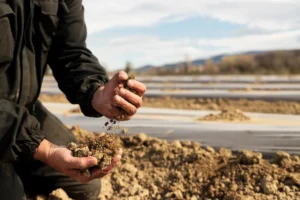
In B2B, quality is a hard promise to keep, because a peak is not enough: you need consistency. And consistency is not created at the end of the packing line; it starts in the soil. This is why, at Top Melon, soil work is an integral part of the quality of our melons, not an agronomic topic separate from the commercial result.
When a melon is consistent in sweetness, aroma and texture, there is almost always a crop grown in balance behind it: correct nutrition, sensible water management, and soils kept alive and well structured. It is the same thread we follow, from the practical side, in our article on sustainability and soil structure. Here we look at it through the eyes of the buyer: why soil is the first lever of consistent quality, lot after lot.
Strong soil, stable plant, uniform produce
Well-managed soil is not a passive support: it works as a system. It improves the ability to hold and distribute water, encourages more regular, less stressed roots, makes nutrient uptake more efficient and increases resilience at critical moments of the season. All this results in a plant that responds more predictably, and a predictable plant is the basis of more uniform lots.
Conversely, compacted or depleted soil works against the crop: water stagnates or runs off, roots struggle to explore the soil and the plant becomes more vulnerable to stress. The typical result is unevenness, the number one enemy of anyone who has to guarantee a standard. Caring for soil structure therefore removes one of the first causes of variability, before we even talk about the fruit.
There is also an economic side that speaks directly to buyers: a more stable agronomic system reduces waste and non-conformities, and less waste is real sustainability as well as recovered margin.
The advantage of the Umbrian terroir (and why it is not enough on its own)
The soils of the middle Tiber valley are naturally fertile, and the marked night-time temperature drop typical of Umbria helps melons build up sugars and develop well-defined aromas. It is a valuable starting point. Growing on land that allows wide crop rotations, a practice that has always characterised the way we work, also helps maintain fertility and break the cycles of some pathogens. But a good terroir must be backed by method: without careful management of organic matter, nutrition and water, even the best setting gives inconsistent results. That is the difference between a “lucky field” and reliable supply.
Five pillars of our soil work
1) Organic matter and soil life. Soil is not just chemistry: it is structure and biology. Organic matter improves aggregate stability, infiltration and water retention, and feeds the microbial activity that makes nutrients available. A “living” soil supports the crop with fewer constant corrections, which is why, when we talk about quality, we talk not only about the fruit but about the production ecosystem.
2) Balanced nutrition throughout the cycle. An excess “today” often becomes a problem “tomorrow”. In melons, for example, unbalanced nitrogen pushes foliage at the expense of the fruit and can lead to softer flesh and shorter shelf life, while good nutritional balance accompanies the plant through its stages without swings. This is where fertigation comes in, combining water and nutrients in a controlled way, as we explain in our blog (fertigation and beneficial nematodes).
3) Water and soil are one decision. No nutrition programme works if water management is erratic: water carries the nutrients and determines how the plant absorbs them. This is why we always link soil to water management: water resources, the use of data and tools (weather stations) and a precision agriculture approach. Together, soil and water determine much of the final consistency.
4) A healthy root system: grafting as an ally. Fruit quality also depends on healthy roots, which must work well to absorb water and nutrients. Where soil pathogen pressure is present, grafting is an important agronomic lever to give the plant a stronger, more resilient root system, as we explain in our article on melon grafting. More efficient roots mean a plant less prone to sudden “dips”, and therefore more regular lots.
5) From theory to result: checks and post-harvest. Soil work has to show up in a measurable way. This is where quality controls come in (our packhouse grading also uses a Brix meter) together with post-harvest management at the packhouse. This bridge turns good agronomic work into a standard product for wholesale markets and retailers.
The hidden cost of unevenness
To see why soil is a commercial topic, just think about waste. An uneven lot forces stricter grading, produces more out-of-spec fruit and increases the risk of claims further down the chain. Every fruit that misses the standard is a cost: of production, of packing and of lost sales. Working on the soil means acting upstream on these losses, reducing the share of produce that fails to reach the required standard.
Then there is mineral nutrition. Beyond nitrogen balance, elements such as potassium play a recognised role in fruit quality, from sugar management to texture, which is why well-balanced nutrition throughout the cycle is not a technical detail but one of the conditions for consistency. It is the sum of these details, more than any single intervention, that makes the difference between supply that is “sometimes excellent” and supply that is reliable.
Why all this matters to buyers
A buyer does not buy “well-managed soil”: they buy fruit that meets the standard consistently. But it is precisely the chain from soil to roots to water to nutrition that determines how solid that consistency is. A supplier who starts from the soil tends to offer fewer surprises over time, because they work on the causes of variability, not just the symptoms. It is a quiet but real competitive advantage.
When the logo is missing, quality must speak for itself
In large retail the Top Melon brand is not always visible. But buyers and category managers immediately notice the differences that count: uniformity, waste, complaints and turnover. Quality is the sum of many choices, and soil is one of the first on the list. We grow with love, but we start from where nobody looks: the soil.
We grow with love. Want to see how our method becomes supply chain and product? Discover the Top Melon supply chain.
FAQ
Why talk about soil in a B2B blog?
Because soil is one of the main levers of consistent quality, and consistency is what reduces complaints, waste and commercial problems. For a buyer it is anything but abstract.
How does organic matter affect melon quality?
It improves structure, infiltration and water retention and feeds the biological activity of the soil: a plant grown in more stable soil tends to give fruit that is more uniform in sweetness and texture.
How are nutrition and uniformity (Brix, size) linked?
Balanced nutrition throughout the cycle reduces the swings that cause unevenness; excess nitrogen, for example, can lower fruit quality. Packhouse checks then verify the standard, for instance on sugar content.
Why is grafting linked to soil quality?
Because a strong rootstock gives the plant roots that are more resistant to soil pathogens and more efficient at uptake, which helps consistency especially where root disease pressure is high.
Why are water and soil dealt with together?
Because nutrition only works if water is managed well: water carries the nutrients. They are two sides of the same agronomic decision.
Is the Umbrian terroir enough to guarantee quality?
It is an excellent starting point, with fertile soils, wide rotations and cool nights, but it must be backed by method: management is what turns potential into consistent supply.
Where can I read more about sustainable practices in melon growing?
In our article on sustainable melon growing and soil biodiversity and structure, which describes the practices mentioned here in detail.