
Interest in vegetable grafting has grown worldwide in recent years. By physically joining a plant with desirable fruit traits (the scion) onto another plant with resistance to specific diseases or tolerance of stress (the rootstock), grafted plants combine the benefits of both the rootstock and the scion cultivar. Grafted plants are, however, more expensive than regular transplants.
Grafting as a cultural practice to control soil-borne diseases and improve tolerance of abiotic stress has been widely used in the production of tomato (Solanum lycopersicum L.), aubergine (Solanum melongena L.), pepper (Capsicum annuum L.), watermelon (Citrullus lanatus [Thunb.] Matsum. & Nakai), melon (Cucumis melo L.) and cucumber (Cucumis sativus L.) in many parts of Asia and Europe.
Cost, together with the wish to choose their own scion cultivars and the need to produce organic transplants, has led many growers to graft their own plants. However, achieving a high graft survival rate can often be quite difficult, especially in the first attempts.
Several methods are used commercially to graft solanaceous and cucurbit vegetables (Lee and Oda 2002; Lee et al. 2010). Although melon grafting follows the same principles as grafting other vegetables, it has some specific features. First, both rootstock and scion plants develop hollow hypocotyls soon after seed germination, and this central cavity widens as the hypocotyls thicken. Hollow hypocotyls reduce the contact area between rootstock and scion tissue, so grafting should be done on young seedlings while the central cavities are still small. Second, unlike tomato grafting, where scions can be cut above the cotyledons, melon scions are usually cut in the hypocotyl area, keeping both cotyledons. The cotyledons add leaf area and can cause greater water loss in newly grafted melon plants than in tomato plants. Third, the rootstocks used for melon can be intraspecific or interspecific and can have varying hypocotyl diameters, so grafting methods must be adapted to the rootstock species and hypocotyl size.
Interspecific hybrid squashes are widely used as melon rootstocks (King et al. 2010). They are highly resistant to fungal wilt and also have better tolerance of low temperatures and saline conditions.
The advantages of grafting melons onto melon rootstocks include fewer problems with incompatibility and fruit quality.
Hole insertion grafting
First, the true leaves and the meristem tissue are removed from the growing tip of the rootstock. A slit is then made through the growing point, from the base of one cotyledon to the other side of the hypocotyl. A sharpened stick such as a toothpick can be used as the insertion tool. Leave the stick in the growing point while cutting the scion hypocotyl into a V shape on both sides. The scion is then inserted into the slit as the stick is removed.
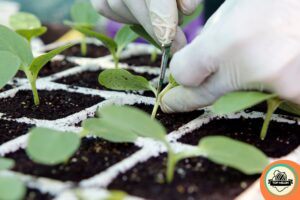
Hole insertion grafting produces high-quality grafted transplants because it maximises the contact surface between rootstock and scion and protects the graft union with both rootstock cotyledons. Another advantage is that it does not require grafting clips, which lowers the cost of grafting and the work of collecting clips after healing.
Hole insertion works best with hybrid squash rootstocks, which normally have thicker hypocotyls than melon scions. Because of the hollow hypocotyl issue, rootstocks with more than two expanded true leaves should be avoided. The ideal time to graft the scions is when the first true leaves begin to emerge but are not fully expanded: at this stage the hypocotyls are strong enough to handle while still easy to insert into the rootstock slits. As the ideal plant size range for this method is fairly narrow, timing the sowing of rootstock and scion seeds is critical. With a new rootstock or scion cultivar, it is advisable to check the relative germination and growth rates of both before grafting on a large scale with this method.
Splice grafting
Splice grafting is simpler than hole insertion grafting. First, the growing tip of the rootstock is cut at a 45 degree angle, removing the true leaves, the meristem tissue and one of the cotyledons. The scion hypocotyl is then cut at the same angle as the rootstock, and the scion is attached to the rootstock with a grafting clip.

This method is best suited to melon rootstocks, as it works best when rootstock and scion have similar hypocotyl diameters. Hybrid squash rootstocks are also grafted this way because the method is simple. However, since hybrid squash rootstocks generally have thicker hypocotyls than melon scions, the scion seeds can be sown before the rootstock seeds. Grafting should be completed immediately after cutting, so that neither the scion nor the rootstock surfaces dry out, to improve the survival rate of grafted plants.
Post-grafting healing
With both hole insertion and splice grafting, keeping humidity high and temperatures favourable during the first 48 hours after grafting is essential for success. The optimal temperature is around 28°C (82°F) with relative humidity between 95% and 100%. Trials have shown that temperatures below about 21°C (70°F) and/or average relative humidity below 85% in the first 48 hours can cause the graft to fail. If the scions wilt badly during this period, their chances of recovery are very low. Low light conditions may be needed to reduce water loss through transpiration and evaporation.
After the critical 48 hours, gradually reducing humidity and increasing light is important for graft healing and disease prevention. For small-scale grafting, storage containers can be used for post-graft healing: the container should be covered or kept in low light during the critical hours, and high humidity can be maintained by leaving a thin layer of water on the bottom and/or spraying water inside the closed container. After the critical hours, humidity is gradually reduced by partly opening the container while more light is let in. More information on building healing chambers can be found in Johnson et al. (2011). For large-scale grafting, healing chambers holding several seedling trays can easily be built inside a greenhouse. Commercial post-graft healing normally uses poly-covered healing structures inside greenhouses, or germination or storage rooms with humidity and temperature control.
Growth
Because the meristem tissue is not always fully removed, regrowth from the rootstock (rootstock suckers) can be a problem with hole insertion and splice grafting. Suckers should be checked for and removed before transplanting into the field. However, they can keep emerging in the field, which can become one of the main drawbacks of grafted transplants. Tongue approach grafting avoids rootstock suckers by completely removing the apical meristem of the rootstock.
In short, each grafting method has its own advantages and challenges. The choice of the most suitable method and technique for producing grafted melon transplants will depend on available space, labour and resources, the rootstock and scion cultivars, the grafter’s experience and, finally, economic considerations.