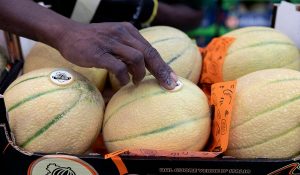
Top Melon is a family farm founded in 1995 in Umbria, when the Spinetti family began growing melons in the heart of the middle Tiber valley (about the Top Melon farm). Over the years we have built a model designed above all for B2B: wholesale fruit and vegetable markets and large retail chains. In this context, “quality” does not mean a melon that is good once, but something far more demanding: continuity, repeatable standards, traceability and predictability, lot after lot.
This is exactly where our decision to certify our melons under SQNPI comes in. It is not a marketing badge but a framework that requires us to work in a structured way and to make our integrated production approach verifiable. For a buyer this means something concrete: behind the product there is a documented method, not improvisation.
A useful note for buyers: in large retail, melons often arrive in neutral packaging or under private label and do not carry the Top Melon brand at the point of sale. That is normal. What stays exactly the same is the supply chain method (discover our supply chain) that governs the product from field to delivery.
What exactly is SQNPI?
SQNPI stands for Sistema di Qualità Nazionale di Produzione Integrata, Italy’s National Integrated Production Quality System. It is a voluntary certification scheme set up by the Italian Ministry of Agriculture (today MASAF), operational since January 2016 and applicable to fresh and processed plant products. It is not a self-declared label: it is a system with written rules and third-party controls.
At its core are the integrated production guidelines (disciplinari): technical rules defined for each crop that set out precisely how to work in the field. In practice, a guideline covers aspects such as:
- permitted agronomic practices (crop sequence and rotation, variety choice, fertilisation management);
- binding plant protection rules, with restrictions on the products that may be used and on the maximum number of treatments per season;
- recording of operations, so that every intervention can be traced afterwards.
Integrated production under SQNPI also meets the legal requirements on integrated pest management set by Italy’s National Action Plan on the sustainable use of plant protection products, which implements EU Directive 2009/128/EC. In other words, it is not an add-on disconnected from the law: it builds on the framework that regulates the responsible use of chemicals in farming and takes it to a higher level of rigour.
When the requirements are met and verified by a control body, the farm can use the ministerial “Qualità Sostenibile” (Sustainable Quality) mark on the certified product, the logo with the ladybird, which tells the market that the crop was grown with techniques that respect the environment and health.
Worth knowing: SQNPI is a national Italian scheme, designed for the Italian market and to promote integrated production. It sits well alongside the international standards required by major retailers, which follow a complementary commercial logic. For a serious supplier they are not conflicting alternatives but pieces of the same set of guarantees.
Why SQNPI matters for melons in particular
Melon is an “honest” product: it quickly shows the effects of careless management. Lack of uniformity, swings in sweetness and poor holding after a few days on the distribution platform are the problems buyers fear most, because they lead to complaints, waste and slow turnover.
Working within a framework like SQNPI helps contain precisely the most “invisible” variability, the kind that does not show at delivery but emerges further down the chain. It also makes it easier to talk clearly about lots, checks and traceability, and keeps the season more stable. In commercial terms:
- fewer surprises after a few days on the shelf or platform;
- more predictable standards, which make purchase planning easier;
- stronger supplier qualification, because the buyer can rely on a verified system rather than on promises.
For a purchasing department, this last point weighs more than it seems: due diligence on a new supplier is faster when a certification scheme already guarantees how the product is grown.
What it means in Top Melon’s daily work
Integrated production is not a single “green” choice: it is a coherent set of decisions that hold together.
1) Crop protection: prevent first, then intervene with judgement. The first goal is to reduce the need for intervention and, when needed, to choose effective, lower-impact solutions. This is the approach we describe in our article on integrated pest management: monitor, respect thresholds and favour the most sustainable solutions when they are genuinely compatible with the result, avoiding unnecessary “insurance” treatments.
2) Soil and nutrition: quality starts before the fruit. Sweetness, aroma and texture are not built at the end of the packing line; they start in the soil and in crop management. Balanced nutrition, without excesses that boost the plant at the expense of the fruit, is an integral part of integrated production, in line with the technical articles on biodiversity and soil structure in our blog (growing melons and soil structure).
3) Traceability: the bridge between field and delivery. In B2B, traceability is a management tool, not a theory: it allows the product’s journey to be reconstructed and any non-conformity to be handled quickly. At the packhouse each lot receives a lot number, and every item in contact with the fruit (crates, labels, trays) is identified and managed with its own traceability, as we explain in our articles on traceability in the melon supply chain and on supply chain traceability certification.
4) Checks: quality is measured, not hoped for. Work in the field only becomes a standardised product if it is verified. This is why quality controls are a pillar, together with the procedures that protect the product in its most delicate phase, the step from harvest to packing to shipment. In our packhouse, grading is done with modern machinery, including a Brix meter that makes the assessment of sweetness objective rather than relying on the operator’s experience alone.
Same rules for every type of melon
Melon covers different types, netted, smooth and canary, and none is “better” in absolute terms: what matters is consistency with the standards the customer requires. Netted melon is the main share of our range, but the method is the same across all our products (melons, netted melon, smooth melon, canary melon). This uniform approach is in itself valuable for buyers: the guarantee does not depend on the individual variety but on the system.
When the logo is not visible, the method is
In fresh produce, the end consumer often does not know “who” is behind a product. But retailers and wholesale markets understand it very well, and they read it in shelf life, complaints, yields, continuity of supply and stable quality. SQNPI on our melons is part of this promise: we grow with love, but we do it with rules, procedures and checks.
We grow with love. Want to see how we work from field to distribution? Discover the Top Melon supply chain.
FAQ
What is SQNPI certification, in short?
It is Italy’s National Integrated Production Quality System: a voluntary scheme set up by the Italian Ministry of Agriculture, operational since 2016 and based on crop-specific production rules that govern agronomic practices and plant protection treatments. When the requirements are verified, it allows the “Qualità Sostenibile” (Sustainable Quality) mark to be used on the certified product.
Does SQNPI apply to all Top Melon products?
In our case it applies to melon. For other products we only communicate a certification when it is actually applied and verified, so as not to create expectations that the facts do not support.
What is the difference between SQNPI and standards such as GLOBALG.A.P.?
SQNPI is an Italian national scheme focused on integrated production, while international standards mainly respond to the requirements of retailers across markets. They do not conflict: they cover complementary needs and can coexist on the same farm.
If the melon reaches the retailer unbranded, does SQNPI still matter?
Yes. In B2B the value lies not in the label but in the process: the guarantee is in the supply chain and the checks, which stay exactly the same in neutral or private label packaging.
How do SQNPI and traceability relate?
Integrated production defines how the crop is grown; traceability is how we link field and delivery and manage non-conformities. The two reinforce each other.
Does SQNPI affect the quality that reaches the shelf?
Indirectly, yes: more disciplined management of crop protection, soil and nutrition tends to reduce quality fluctuations, and packhouse checks then confirm the standard before shipment.
Where can I learn more about the agronomic method behind SQNPI?
Start with our articles on integrated pest management and soil structure, which describe the practices the certification is built on.