
Protecting water resources
In recent decades there has been much talk about climate change, but often as something not entirely tangible: we know it exists, and we know or assume its possible effects, yet they were not fully visible in everyday life. That is no longer the case.
Without going too far back, we only need to look at the most recent growing season, when a dramatic lack of water in agriculture showed itself in severe drought.
Using water in agriculture as a production input raises far more serious issues than other inputs, both because, as a natural resource, it cannot be produced industrially, and because its use by one party excludes use by others. This creates strong competition with other uses (domestic, industrial, drinking water and recreation).
It is easy to see, then, that today more than ever irrigation water must be used more and more rationally, with management that preserves the resource itself. In other words, agronomic practices, crop choices, timing and working methods must increasingly help to protect and control this resource, especially where erosion and shortages are significant, as is the case in Italy.
How should water be managed?
Increasing irrigation efficiency through careful management is a necessary step for consistent and sustainable agricultural production, from an economic and, above all, an environmental point of view.
Water management is a highly complex challenge because it depends on several factors: major climate change, a constantly growing population and food waste.
Better water management therefore cannot and must not be a priority for agriculture alone: everyone (other players in the supply chain, consumers and the sectors involved) must do their part to achieve it.
Consumers certainly play a decisive role. Careful water management in agriculture requires transparency on how water is used in production, and the choice of products should be closely linked to the amount of water used to produce them. Some farm products require more water than others, and public awareness of this should grow and spread considerably, leading to more informed, careful and sustainable behaviour and choices.
Farms also play an important role. Through water labelling and certification schemes that account for the water used in production, they can help consumers become more aware of how much water goes into a given food product, and guide their choices. Only in this way will the most “virtuous” production processes be recognised and their sustainability highlighted. This is strategic not only for environmental policy but also commercially, as consumers are increasingly willing to reward this effort by buying products that respect and protect water resources.
However, this commitment alone is not enough. It also depends on the available technology and in particular on precision agriculture techniques, which have become indispensable because they allow water to be distributed efficiently in the field, both in space and in time.
Today there are major challenges, given the serious threats and conflicts arising from environmental phenomena, such as water scarcity caused mainly by lack of rainfall, and from the complex sharing of water between different uses (domestic, industrial, agricultural), which determines how much is available for crops.
At Top Melon
Umbria is still a region rich in this vital resource; being aware of it and preserving it is a duty towards everyone.
Even though we live and work in areas with plenty of water, it is essential for all of us to understand that a river drying up, a water table dropping or a rural well becoming polluted are events that an environment already under daily pressure can no longer bear.
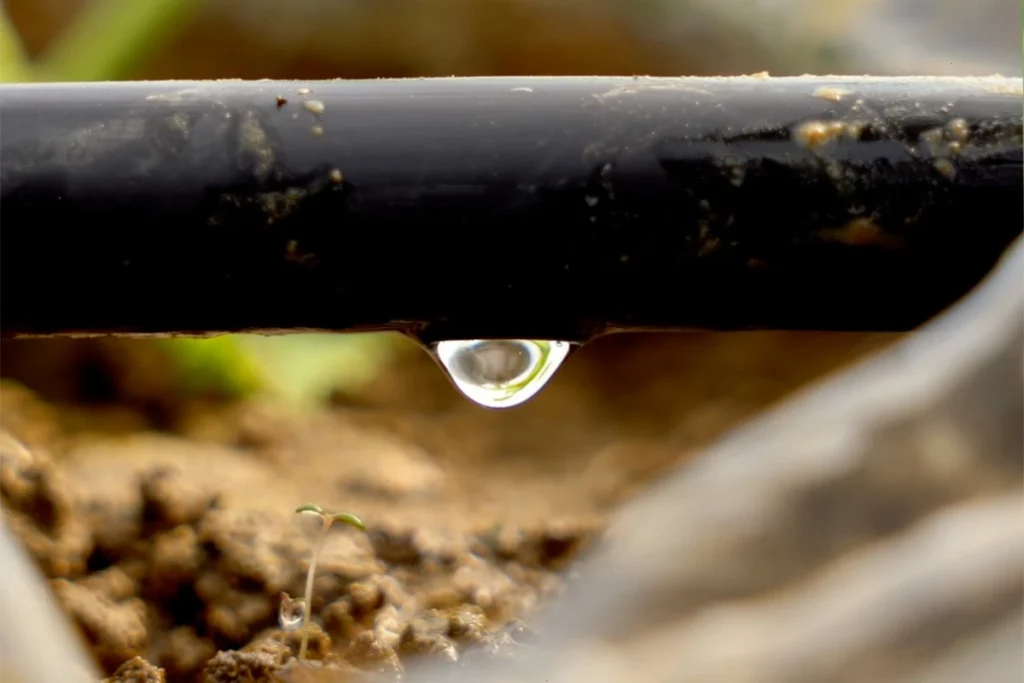
The damage is to a resource that is increasingly showing its limits: water is an essential good that must be preserved, not only for sound economics but out of necessity. At Top Melon we have understood this and try to do our part by adopting the best growing and irrigation solutions. Both in open fields and in greenhouses, our vegetables are irrigated with drip micro-irrigation, which places water close to the plant and wets only a small portion of soil, delivering small volumes of water. Compared with furrow irrigation, uniformity and irrigation efficiency are much higher, allowing water to be used rationally.
This is because localised drip irrigation:
• does not wet the entire soil surface, greatly reducing water loss through evaporation from the soil and the growth of weeds;
• does not wet the leaves, reducing evaporation of water from the foliage and avoiding a humid environment that favours several fungal diseases;
• removes or reduces the negative effect of wind on water loss and on the uniformity of wetting;
• allows machinery to move through the field for crop operations even during or straight after irrigation.
We are also helped by mulching films, which stop water from evaporating under the effect of sun or wind, and by a range of decision support systems (weather stations and sensors), which we will cover in a future article.


