
In melon growing, water is one of the most delicate variables. It affects not only yield and plant health but also the uniformity and commercial quality of the fruit. In B2B this translates into a simple rule: less variability means fewer problems along the whole chain, from the distribution platform to shelf life.
This is why we have chosen to work with the SPRING programme, in line with our vision: we grow with love, but we manage resources and processes with method. If you want the full technical explanation of the programme, you will find it in our dedicated article (SPRING, Sustainable Program for Irrigation and Groundwater Use). Here the aim is different, and openly commercial: to explain why serious water management is an advantage for the buyer.
SPRING in brief: what it really adds
SPRING (Sustainable Program for Irrigation and Groundwater Use) is an add-on to the GLOBALG.A.P. standard dedicated to sustainable water management. It does not simply ask growers to “save water”: it asks them to demonstrate, with documentation, how water is abstracted, distributed and monitored. In practice, a programme of this kind works on several fronts:
- legal abstraction, that is, water use in line with permits and local rules;
- protection of water sources, with attention to the aquifers and water bodies used;
- irrigation efficiency, to deliver the right amount of water at the right time;
- recording of consumption and continuous improvement, so that water use is measured and can be improved over time.
This is exactly the kind of guarantee retailers value, especially international ones: it moves sustainability from intentions to verifiable evidence. As ESG criteria increasingly enter supply specifications, being able to show serious water management is no longer a nice-to-have but a requirement that appears more and more often. And since melon is a crop with significant water needs, a structured method for managing water is not only good for reputation: it is a technical condition for growing well, year after year.
Why water changes melon quality (in ways the buyer can see)
There is a precise agronomic reason why irrigation must be managed carefully in melons. Unbalanced irrigation, too much or too little, or badly timed, produces effects that show up later:
- excess water close to ripening tends to “dilute” sugars, giving less sweet fruit at risk of cracking;
- sudden water stress causes uneven size and ripening within the same lot;
- a stressed crop is also more exposed to plant health problems, and therefore to waste.
For buyers this means that water management is not just “an agronomist’s topic”: it is one of the levers that determine how many fruits in a lot meet the standard and how many are discarded. A good practical rule in melon growing is to reduce water gradually as harvest approaches to encourage sugar concentration, an operation that requires control and data, not improvisation.
From theory to practice: how we manage water in our melons
Talking about water management is easy; demonstrating it consistently takes discipline. Our approach relies on a few operational levers, which we apply here to melon.
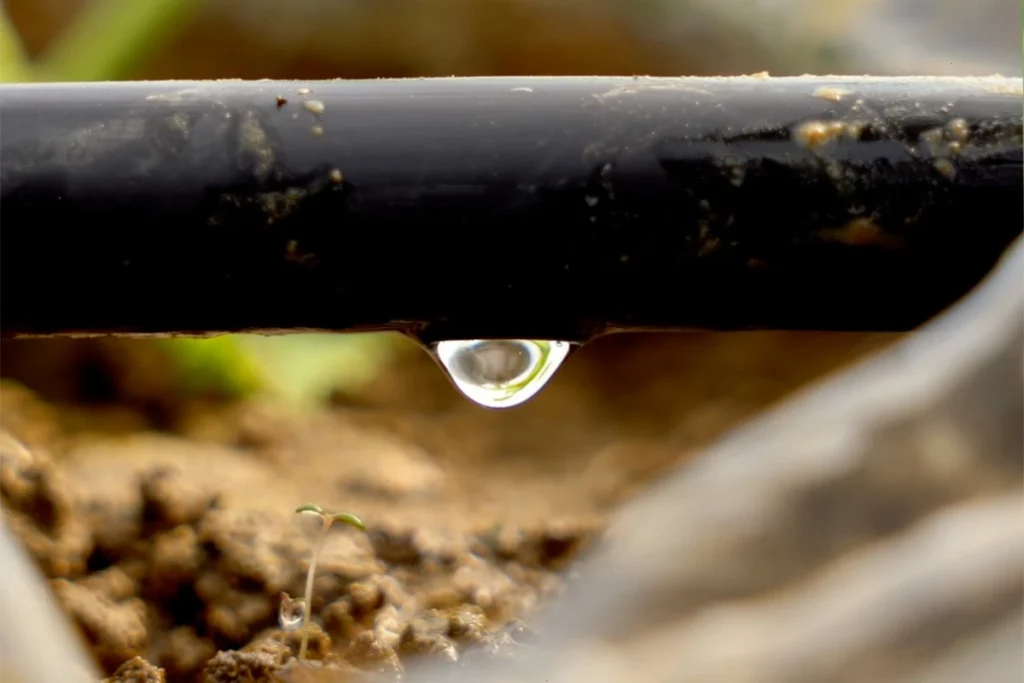
1) Localised, efficient irrigation. We prefer to deliver water where it is needed, reducing losses and waste. Drip irrigation, combined with practices such as mulching, limits evaporation from the soil and weed growth, benefiting both efficiency and crop health. We cover this in our article How should water be managed?: rational water management is a condition for consistent production, not a detail.
2) Deciding with data, not by instinct. To irrigate when it is needed, and not when “we think it is needed”, data quality is decisive. In our blog we have described the use of weather stations in agriculture and, more generally, the precision agriculture approach. For melons this means backing irrigation decisions with real information (weather trends, soil moisture and field conditions) to match interventions to the plant’s actual needs.
3) A helpful setting: the Umbrian climate. Melons grown in the middle Tiber valley benefit from the marked day-night temperature range typical of Umbria, which supports sugar build-up and aroma development. But a favourable setting makes it even more important not to waste the advantage with approximate water management: discipline is what turns a good terroir into a consistent product.
Why it matters to buyers: stable quality means stable business
For buyers, sustainability counts, but stability counts at least as much. A melon irrigated with care, less subject to stress and with more uniform ripening, is a melon that:
- holds up better through logistics and platform times;
- performs better on the shelf, with less weight loss and deterioration in appearance;
- reduces claims and waste, and therefore hidden costs.
There is another, often underestimated level: continuity of supply. In dry years, the farm that has learned to manage water with method is the one that can stay on the market regularly, while those without tools and data are at the mercy of the season. For a buyer, a supplier able to cope with difficult seasons is worth much more than one who only does well in good weather.
These benefits are not just theory: they are verified in the packhouse, where quality controls confirm the standard before shipment, and in the post-harvest phase at the packhouse, where the quality built in the field must be protected.
Water and a changing climate: a topic set to matter more
Water availability and quality can no longer be taken for granted. Dry seasons, restrictions on abstraction and growing regulatory attention are making water management one of the central issues of modern agriculture. For a farm supplying wholesale markets and retailers, this has a direct consequence: those who have already structured their water management, with data, procedures and records, have an advantage when rules tighten or the season is difficult.
It is therefore not only an environmental issue but one of commercial resilience. A programme like SPRING pushes exactly in this direction: it requires growers to know their numbers, document them and improve them over time. And a supplier who knows their numbers is one a buyer can count on, even in years when water becomes critical.
Water is not a separate topic: it is part of the supply chain
When we talk about our supply chain, we do not mean only a sequence of steps, but a way of controlling the final result. Water management in our melons is one of the pillars that makes everything downstream more predictable: harvest, packing and deliveries. This is why, for us, a programme like SPRING is not environmental marketing but production organisation.
We grow with love. Want to see how our method becomes consistent produce? Discover the Top Melon supply chain.
FAQ
What is the SPRING programme?
It is an add-on to the GLOBALG.A.P. standard dedicated to the sustainable management of water and groundwater: it checks legal water use, protection of water sources, irrigation efficiency and recording of consumption. The full technical explanation is in our dedicated article.
Does SPRING apply to all Top Melon crops?
Here we refer to it for melon. As with every certification, we only communicate it where it is actually applied and verified.
Why does water management matter to a buyer and not just to the agronomist?
Because a crop with balanced water supply gives more uniform lots, with more regular ripening and less waste: produce that holds up better through logistics and on the shelf and generates fewer complaints.
Can too much or too little water be seen in the fruit?
Yes, but often further down the chain: excess water close to harvest tends to reduce sweetness and encourage cracking, while water stress creates uneven size and ripening within the same lot.
Which tools does Top Melon use to decide when to irrigate?
We rely on objective data (weather, moisture, field conditions) in line with precision agriculture and weather stations, to irrigate according to the plant’s real needs.
How are water management and continuity of supply linked?
Efficient, documented water management helps cope better with difficult seasons: for a buyer this means a more reliable supplier even when the weather does not help.
Where can I learn more about Top Melon’s approach to water?
In our article on how to manage water resources, which explains the operational choices that our melon work is also based on.


